Shopify Abandoned Cart Recovery on WhatsApp: Timing, Messages and Offers
How to set up abandoned cart reminders on WhatsApp for a Shopify store: when to send, what to write, when to offer a discount and how to measure what you recover.
 WALoops team
calendar_month
schedule4 min read
WALoops team
calendar_month
schedule4 min read
In this guide
- WhatsApp cart reminders work because they arrive where Indian shoppers already are, and they link straight back to the same cart.
- You can only message shoppers who gave you their phone number at checkout and agreed to hear from you.
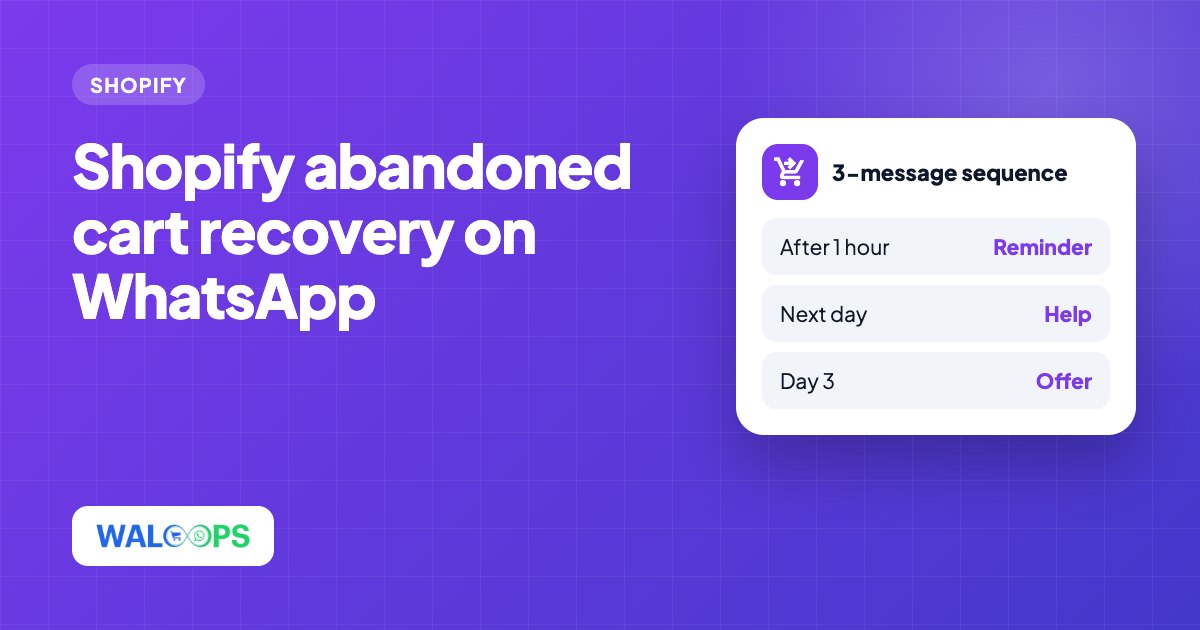
- A good sequence is 2 or 3 messages: a plain reminder within the hour, a helpful follow-up the next day, and an offer only at the end.
- Cart reminders are marketing messages (₹0.8631 each in India), so one recovered order pays for hundreds of reminders.
Most people who start a checkout don't finish it. Some were only comparing prices, but many were interrupted, unsure about delivery time or waiting for payday. An abandoned cart reminder brings the second group back. Email is the traditional channel, but in India a lot of shoppers rarely open marketing email. WhatsApp reminders get seen.
Who you can send cart reminders to
You can send a cart reminder when a shopper has:
- Entered their phone number at checkout, so you know who they are, and
- Agreed to receive messages from you on WhatsApp. WhatsApp's Business Policy requires opt-in before you send business messages. A clear line at checkout like "Get order updates and offers on WhatsApp" with a checkbox or a notice is the usual way.
Shoppers who only browsed and never reached checkout can't get a cart reminder, because you don't have their number. That's why checkouts that ask for the phone number first, like a one-panel COD checkout, recover more carts: the number is captured before the shopper leaves.
When to send each message
A sequence of two or three messages works for most stores. More than that starts to feel pushy and gets your number blocked, which hurts your WhatsApp quality rating.
| Message | When | Purpose |
|---|---|---|
| 1. Reminder | 30 to 60 minutes after leaving | Catch shoppers who were interrupted. No discount. |
| 2. Help | The next day | Answer the usual doubts: delivery time, COD, returns, sizing. |
| 3. Offer | 2 to 3 days later | A small incentive for shoppers who are still deciding. |
Don't send the first reminder within 5 or 10 minutes. The shopper may still be finishing the payment or looking for their card, and an instant message feels like being watched.
What to write
Keep each message short and specific. Name the product, show the price, and give one button back to the cart. Examples you can adapt:
Message 1: the reminder
Message 2: remove the doubt
Message 3: the offer
A few rules that keep these approved and effective:
- Link to the actual cart, not your home page. Every extra step loses buyers.
- Use the product name, not just "your items". It reminds the shopper what they wanted.
- Keep one call to action. "Complete my order" beats three different links.
- Always let people stop. Include a "Stop" quick-reply or honour replies like "stop" or "not interested".
Should you offer a discount?
Discounts recover more carts, but if every reminder has one, regular customers learn to abandon on purpose and wait for the code. Better practice:
- Keep the first message discount-free. Many of these shoppers were going to buy anyway.
- Offer something only in the last message, and give it a deadline.
- Try free shipping or a free COD fee before a percentage discount. It often costs you less.
- For COD-heavy stores, offering the discount on prepaid payment only both recovers the cart and lowers RTO risk.
What it costs
Cart reminders promote a purchase, so Meta treats them as marketing messages. In India that's ₹0.8631 per delivered message on Meta's own rate, before GST. Platforms that add a markup charge more.
A quick way to check it's worth it: if your average order is ₹1,200 and you send 3 reminders per abandoned cart, you spend about ₹2.59 per cart. Recovering one order in every 100 carts brings back ₹1,200 for about ₹259 of messages.
How to measure recovery
Track these for each message in the sequence:
- Carts reminded: checkouts that got at least one message.
- Recovered orders: orders placed from the reminder link, or by the same phone number within a set window (48 hours is common).
- Recovery rate: recovered orders ÷ carts reminded.
- Revenue per message: recovered revenue ÷ messages sent. This tells you whether a third message is worth it.
- Blocks and stops: if these climb, send fewer messages or send them later.
Setting it up on Shopify
Shopify's built-in abandoned checkout emails don't go to WhatsApp, so you need an app. In the WALoops Shopify app, the cart reminder on WhatsApp is on the Starter plan, and Premium adds up to three reminders on your own schedule. Messages can go from the WALoops number, so there's no Meta setup to start, or from your own branded number. The Shopify WhatsApp integration page lists every message the app sends, and the Shopify WhatsApp order confirmation guide covers the order updates that go alongside cart reminders.
If you already use WALoops for WhatsApp, the same recovery sequence works for other stores too. See abandoned cart recovery, or the WooCommerce abandoned cart guide if you sell on WordPress.